Utility Addendum (Submetering and Allocation)
A Texas residential lease addendum a landlord and tenant sign when the landlord bills the tenant separately for submetered or allocated utilities and services.
Your documents

- States
- Texas
- Transaction type
- Lease
- Edition
- Ed. 11-2026.3
- Last updated
- November 14, 2026
- Review
- Not yet reviewed
- Fields
- 69
These forms are general templates. They are not legal advice, and using them does not make us your lawyer.
Real estate rules differ by state and by deal. Check that a form fits your situation before you sign or send it.
“Not yet reviewed” means no reviewer has checked this form, so it may miss a rule that applies in your state or to your deal. Ask a licensed attorney or real estate professional in your state to read it before you rely on it.
Form text
Utility Addendum (Submetering and Allocation)
Texas · Residential lease addendum · Form RF-TX-6105 · Ed. 11-2026.3
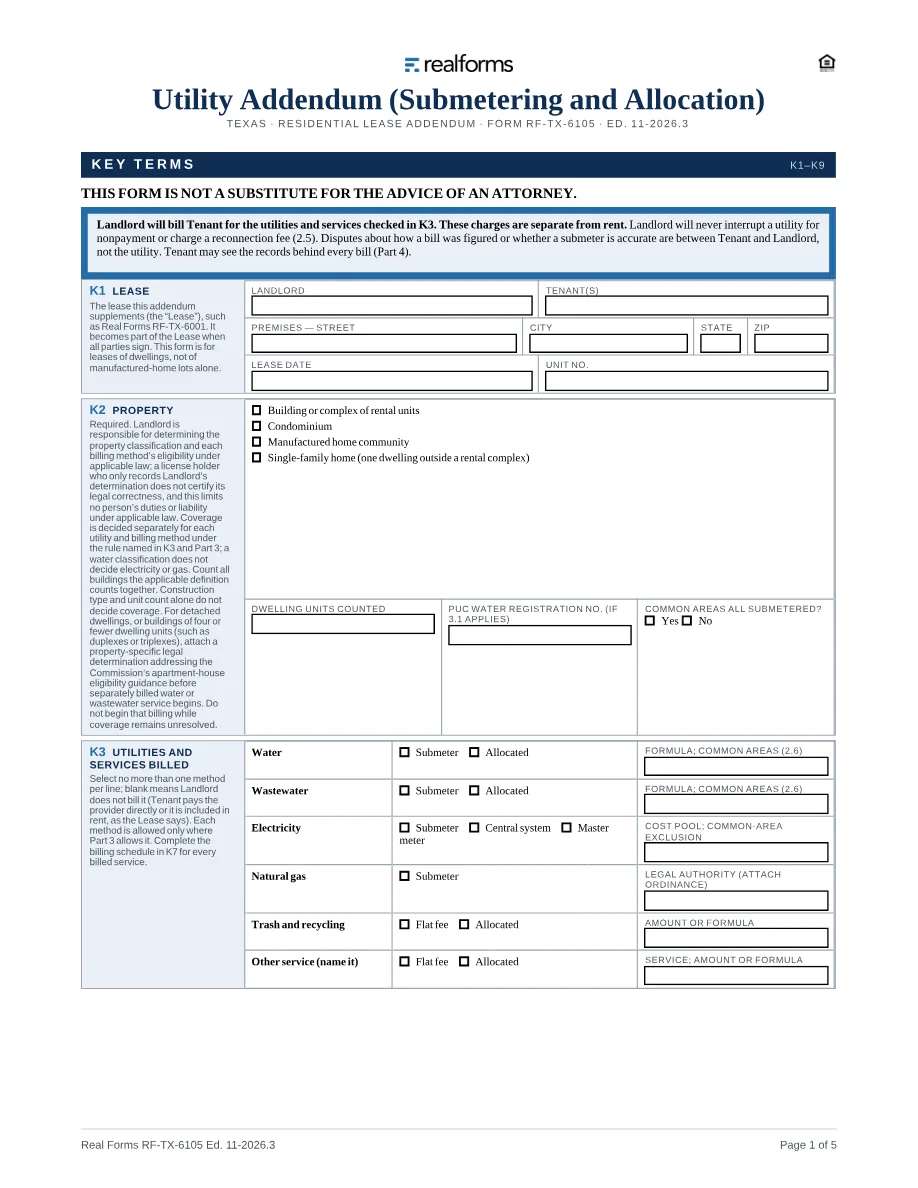
KEY TERMS
K1–K9THIS FORM IS NOT A SUBSTITUTE FOR THE ADVICE OF AN ATTORNEY.
Landlord will bill Tenant for the utilities and services checked in K3. These charges are separate from rent. Landlord will never interrupt a utility for nonpayment or charge a reconnection fee (2.5). Disputes about how a bill was figured or whether a submeter is accurate are between Tenant and Landlord, not the utility. Tenant may see the records behind every bill (Part 4).
K1 Lease
The lease this addendum supplements (the “Lease”), such as Real Forms RF-TX-6001. It becomes part of the Lease when all parties sign. This form is for leases of dwellings, not of manufactured-home lots alone.
Landlord Landlord — owner’s full legal name | Tenant(s) Tenant(s) guaranteed | ||||||||||||||||||||||||||||||||||||||||||||||||||||||||||||||||||||||||||||||||||||||||||||||||||||||||||||
Premises — street Property street address | City Property city | State Property state (text entry) | ZIP Property ZIP code | ||||||||||||||||||||||||||||||||||||||||||||||||||||||||||||||||||||||||||||||||||||||||||||||||||||||||||
Lease date Lease date | Unit no. Unit number | ||||||||||||||||||||||||||||||||||||||||||||||||||||||||||||||||||||||||||||||||||||||||||||||||||||||||||||
K2 Property
Required. Landlord is responsible for determining the property classification and each billing method’s eligibility under applicable law; a license holder who only records Landlord’s determination does not certify its legal correctness, and this limits no person’s duties or liability under applicable law. Coverage is decided separately for each utility and billing method under the rule named in K3 and Part 3; a water classification does not decide electricity or gas. Count all buildings the applicable definition counts together. Construction type and unit count alone do not decide coverage. For detached dwellings, or buildings of four or fewer dwelling units (such as duplexes or triplexes), attach a property-specific legal determination addressing the Commission’s apartment-house eligibility guidance before separately billed water or wastewater service begins. Do not begin that billing while coverage remains unresolved.
Property type: multiunit Building or complex of rental units Property type: condominium Condominium Property type: manufactured Manufactured home community Property type: single-family Single-family home (one dwelling outside a rental complex) | ||
Dwelling units counted Dwelling units counted | PUC water registration no. (if 3.1 applies) PUC water registration no. (if 3.1 applies) | Common areas all submetered? Common areas all submetered?: yes Yes Common areas all submetered?: no No |
K3 Utilities and Services Billed
Select no more than one method per line; blank means Landlord does not bill it (Tenant pays the provider directly or it is included in rent, as the Lease says). Each method is allowed only where Part 3 allows it. Complete the billing schedule in K7 for every billed service.
Water | Water — billing method (blank: not billed by Landlord): submetered Submeter Water — billing method (blank: not billed by Landlord): allocated Allocated | Formula; common areas (2.6) Formula; common areas (2.6) | |||||||||
Wastewater | Wastewater — billing method (blank: not billed by Landlord): submetered Submeter Wastewater — billing method (blank: not billed by Landlord): allocated Allocated | Formula; common areas (2.6) Formula; common areas (2.6) | |||||||||
Electricity | Electricity — billing method (blank: not billed by Landlord): submetered Submeter Electricity — billing method (blank: not billed by Landlord): central Central system Electricity — billing method (blank: not billed by Landlord): master Master meter | Cost pool; common-area exclusion Cost pool; common-area exclusion | |||||||||
Natural gas | Natural gas — billing method (blank: not billed by Landlord): submetered Submeter | Legal authority (attach ordinance) Legal authority (attach ordinance) | |||||||||
Trash and recycling | Trash and recycling — billing method (blank: not billed by Landlord): flat Flat fee Trash and recycling — billing method (blank: not billed by Landlord): allocated Allocated | Amount or formula Amount or formula | |||||||||
Other service (name it) | Other service (name it) — billing method (blank: not billed by Landlord): flat Flat fee Other service (name it) — billing method (blank: not billed by Landlord): allocated Allocated | Service; amount or formula Service; amount or formula | |||||||||
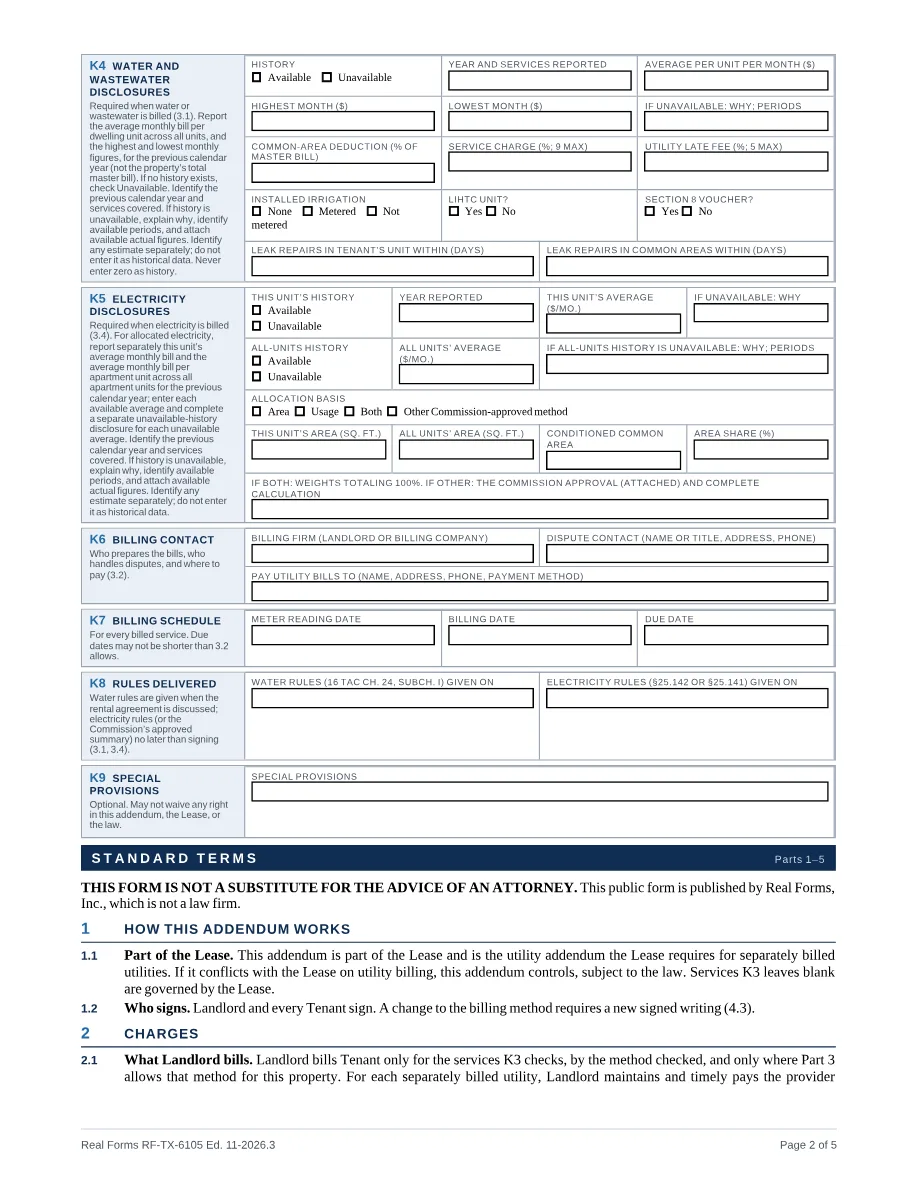
K4 Water and Wastewater Disclosures
Required when water or wastewater is billed (3.1). Report the average monthly bill per dwelling unit across all units, and the highest and lowest monthly figures, for the previous calendar year (not the property’s total master bill). If no history exists, check Unavailable. Identify the previous calendar year and services covered. If history is unavailable, explain why, identify available periods, and attach available actual figures. Identify any estimate separately; do not enter it as historical data. Never enter zero as history.
History History: available Available History: unavailable Unavailable | Year and services reported Year and services reported | Average per unit per month ($) Average per unit per month ($) | |||
Highest month ($) Highest month ($) | Lowest month ($) Lowest month ($) | If unavailable: why; periods If unavailable: why; periods | |||
Common-area deduction (% of master bill) Common-area deduction (% of master bill) | Service charge (%; 9 max) Service charge (%; 9 max) | Utility late fee (%; 5 max) Utility late fee (%; 5 max) | |||
Installed irrigation Installed irrigation: none None Installed irrigation: metered Metered Installed irrigation: unmetered Not metered | LIHTC unit? LIHTC unit?: yes Yes LIHTC unit?: no No | Section 8 voucher? Section 8 voucher?: yes Yes Section 8 voucher?: no No | |||
Leak repairs in Tenant’s unit within (days) Leak repairs in Tenant’s unit within (days) | Leak repairs in common areas within (days) Leak repairs in common areas within (days) | ||||
K5 Electricity Disclosures
Required when electricity is billed (3.4). For allocated electricity, report separately this unit’s average monthly bill and the average monthly bill per apartment unit across all apartment units for the previous calendar year; enter each available average and complete a separate unavailable-history disclosure for each unavailable average. Identify the previous calendar year and services covered. If history is unavailable, explain why, identify available periods, and attach available actual figures. Identify any estimate separately; do not enter it as historical data.
This unit’s history This unit’s history: available Available This unit’s history: unavailable Unavailable | Year reported Year reported | This unit’s average ($/mo.) This unit’s average ($/mo.) | If unavailable: why If unavailable: why |
All-units history All-units history: available Available All-units history: unavailable Unavailable | All units’ average ($/mo.) All units’ average ($/mo.) | If all-units history is unavailable: why; periods If all-units history is unavailable: why; periods | |
Allocation basis Allocation basis: area Area Allocation basis: usage Usage Allocation basis: combination Both Allocation basis: approved-other Other Commission-approved method | |||
This unit’s area (sq. ft.) This unit’s area (sq. ft.) | All units’ area (sq. ft.) All units’ area (sq. ft.) | Conditioned common area Conditioned common area | Area share (%) Area share (%) |
If Both: weights totaling 100%. If Other: the Commission approval (attached) and complete calculation If Both: weights totaling 100%. If Other: the Commission approval (attached) and complete calculation | |||
K6 Billing Contact
Who prepares the bills, who handles disputes, and where to pay (3.2).
Billing firm (Landlord or billing company) Billing firm (Landlord or billing company) | Dispute contact (name or title, address, phone) Dispute contact (name or title, address, phone) |
Pay utility bills to (name, address, phone, payment method) Pay utility bills to (name, address, phone, payment method) | |
K7 Billing Schedule
For every billed service. Due dates may not be shorter than 3.2 allows.
Meter reading date Meter reading date | Billing date Billing date | Due date Due date |
K8 Rules Delivered
Water rules are given when the rental agreement is discussed; electricity rules (or the Commission’s approved summary) no later than signing (3.1, 3.4).
Water rules (16 TAC ch. 24, subch. I) given on Water rules (16 TAC ch. 24, subch. I) given on | Electricity rules (§25.142 or §25.141) given on Electricity rules (§25.142 or §25.141) given on |
K9 Special Provisions
Optional. May not waive any right in this addendum, the Lease, or the law.
Special Provisions |
STANDARD TERMS
Parts 1–5THIS FORM IS NOT A SUBSTITUTE FOR THE ADVICE OF AN ATTORNEY. This public form is published by Real Forms, Inc., which is not a law firm.
1 How This Addendum Works
1.1 Part of the Lease. This addendum is part of the Lease and is the utility addendum the Lease requires for separately billed utilities. If it conflicts with the Lease on utility billing, this addendum controls, subject to the law. Services K3 leaves blank are governed by the Lease.
1.2 Who signs. Landlord and every Tenant sign. A change to the billing method requires a new signed writing (4.3).
2 Charges
2.1 What Landlord bills. Landlord bills Tenant only for the services K3 checks, by the method checked, and only where Part 3 allows that method for this property. For each separately billed utility, Landlord maintains and timely pays the provider account; Tenant reimburses only authorized charges. Landlord pays for common-area utilities except as an allowed allocation includes them, and pays any provider deposit, disconnect, reconnect, late, or similar fee charged to Landlord.
2.2 No markup. Charges for water, wastewater, electricity, and gas may not exceed Tenant’s share of what the provider charged Landlord, calculated under Part 3, plus any service charge K4 allows for submetered water and wastewater. K3 must identify each nonutility service and its specific amount or complete allocation formula, and each is separately itemized. A charge for utility billing, administration, or delivery remains subject to the utility limits regardless of its label. No cost may be recovered twice.
2.3 Separate from rent. Utility and service charges are billed separately (or as a separate, distinct item on a multi-item bill) and are not rent. They do not support rent late fees, a lockout for unpaid rent, or a landlord’s lien for rent. A payment is applied first to rent and then to utilities unless it is paid to a third-party billing company or Tenant clearly designates otherwise. A material failure to pay is subject to the Lease’s notice and cure requirements for breaches other than rent, and to applicable law.
2.4 Moving in and out. Metered consumption is charged for Tenant’s service period without further daily proration. Allocated water and wastewater bills for a partial month are prorated by days as 16 TAC §24.281(e)(3) provides. An early final submetered water or wastewater bill is permitted only when Landlord uses average-cost billing under 16 TAC §24.281(d), and is calculated using Tenant’s preceding three months’ average volumetric rate multiplied by actual consumption for the service period. An early final allocated water or wastewater bill may separately be calculated under §24.281(e)(3), using Tenant’s preceding three months’ average bill, prorated by days. Without enough history, Landlord waits for the actual provider bill. Other final bills use actual charges. Corrections follow 3.3, and a pending utility bill does not extend the security-deposit accounting deadline.
2.5 No interruption. Landlord will not interrupt or cause the interruption of any utility for nonpayment of a utility or service bill and will not charge a reconnection fee. Landlord may interrupt service only for bona fide repairs, construction, or an emergency, as Texas Property Code §92.008 allows.
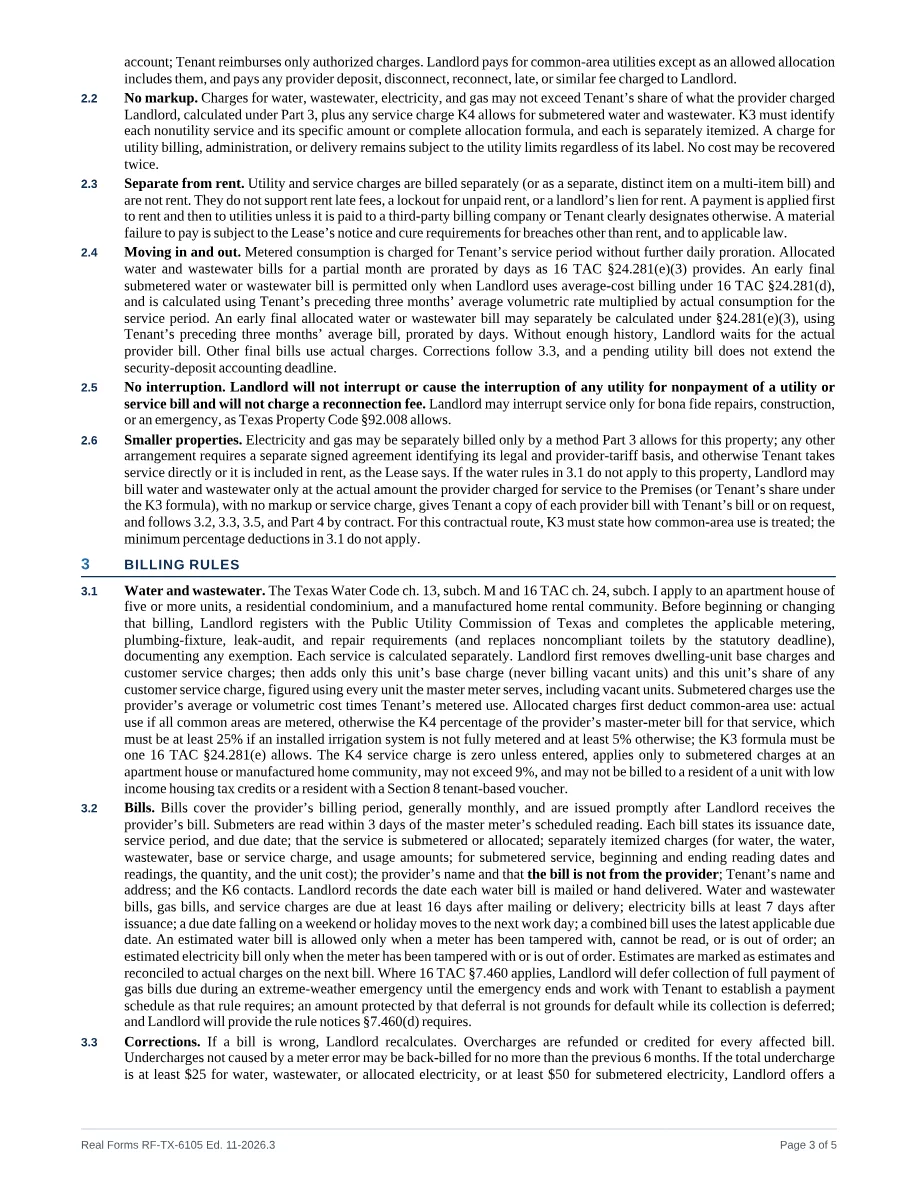
2.6 Smaller properties. Electricity and gas may be separately billed only by a method Part 3 allows for this property; any other arrangement requires a separate signed agreement identifying its legal and provider-tariff basis, and otherwise Tenant takes service directly or it is included in rent, as the Lease says. If the water rules in 3.1 do not apply to this property, Landlord may bill water and wastewater only at the actual amount the provider charged for service to the Premises (or Tenant’s share under the K3 formula), with no markup or service charge, gives Tenant a copy of each provider bill with Tenant’s bill or on request, and follows 3.2, 3.3, 3.5, and Part 4 by contract. For this contractual route, K3 must state how common-area use is treated; the minimum percentage deductions in 3.1 do not apply.
3 Billing Rules
3.1 Water and wastewater. The Texas Water Code ch. 13, subch. M and 16 TAC ch. 24, subch. I apply to an apartment house of five or more units, a residential condominium, and a manufactured home rental community. Before beginning or changing that billing, Landlord registers with the Public Utility Commission of Texas and completes the applicable metering, plumbing-fixture, leak-audit, and repair requirements (and replaces noncompliant toilets by the statutory deadline), documenting any exemption. Each service is calculated separately. Landlord first removes dwelling-unit base charges and customer service charges; then adds only this unit’s base charge (never billing vacant units) and this unit’s share of any customer service charge, figured using every unit the master meter serves, including vacant units. Submetered charges use the provider’s average or volumetric cost times Tenant’s metered use. Allocated charges first deduct common-area use: actual use if all common areas are metered, otherwise the K4 percentage of the provider’s master-meter bill for that service, which must be at least 25% if an installed irrigation system is not fully metered and at least 5% otherwise; the K3 formula must be one 16 TAC §24.281(e) allows. The K4 service charge is zero unless entered, applies only to submetered charges at an apartment house or manufactured home community, may not exceed 9%, and may not be billed to a resident of a unit with low income housing tax credits or a resident with a Section 8 tenant-based voucher.
3.2 Bills. Bills cover the provider’s billing period, generally monthly, and are issued promptly after Landlord receives the provider’s bill. Submeters are read within 3 days of the master meter’s scheduled reading. Each bill states its issuance date, service period, and due date; that the service is submetered or allocated; separately itemized charges (for water, the water, wastewater, base or service charge, and usage amounts; for submetered service, beginning and ending reading dates and readings, the quantity, and the unit cost); the provider’s name and that the bill is not from the provider; Tenant’s name and address; and the K6 contacts. Landlord records the date each water bill is mailed or hand delivered. Water and wastewater bills, gas bills, and service charges are due at least 16 days after mailing or delivery; electricity bills at least 7 days after issuance; a due date falling on a weekend or holiday moves to the next work day; a combined bill uses the latest applicable due date. An estimated water bill is allowed only when a meter has been tampered with, cannot be read, or is out of order; an estimated electricity bill only when the meter has been tampered with or is out of order. Estimates are marked as estimates and reconciled to actual charges on the next bill. Where 16 TAC §7.460 applies, Landlord will defer collection of full payment of gas bills due during an extreme-weather emergency until the emergency ends and work with Tenant to establish a payment schedule as that rule requires; an amount protected by that deferral is not grounds for default while its collection is deferred; and Landlord will provide the rule notices §7.460(d) requires.
3.3 Corrections. If a bill is wrong, Landlord recalculates. Overcharges are refunded or credited for every affected bill. Undercharges not caused by a meter error may be back-billed for no more than the previous 6 months. If the total undercharge is at least $25 for water, wastewater, or allocated electricity, or at least $50 for submetered electricity, Landlord offers a deferred payment plan lasting as long as the underbilling period. Landlord never bills Tenant for a previous occupant’s use or for underbilling caused by a meter error.
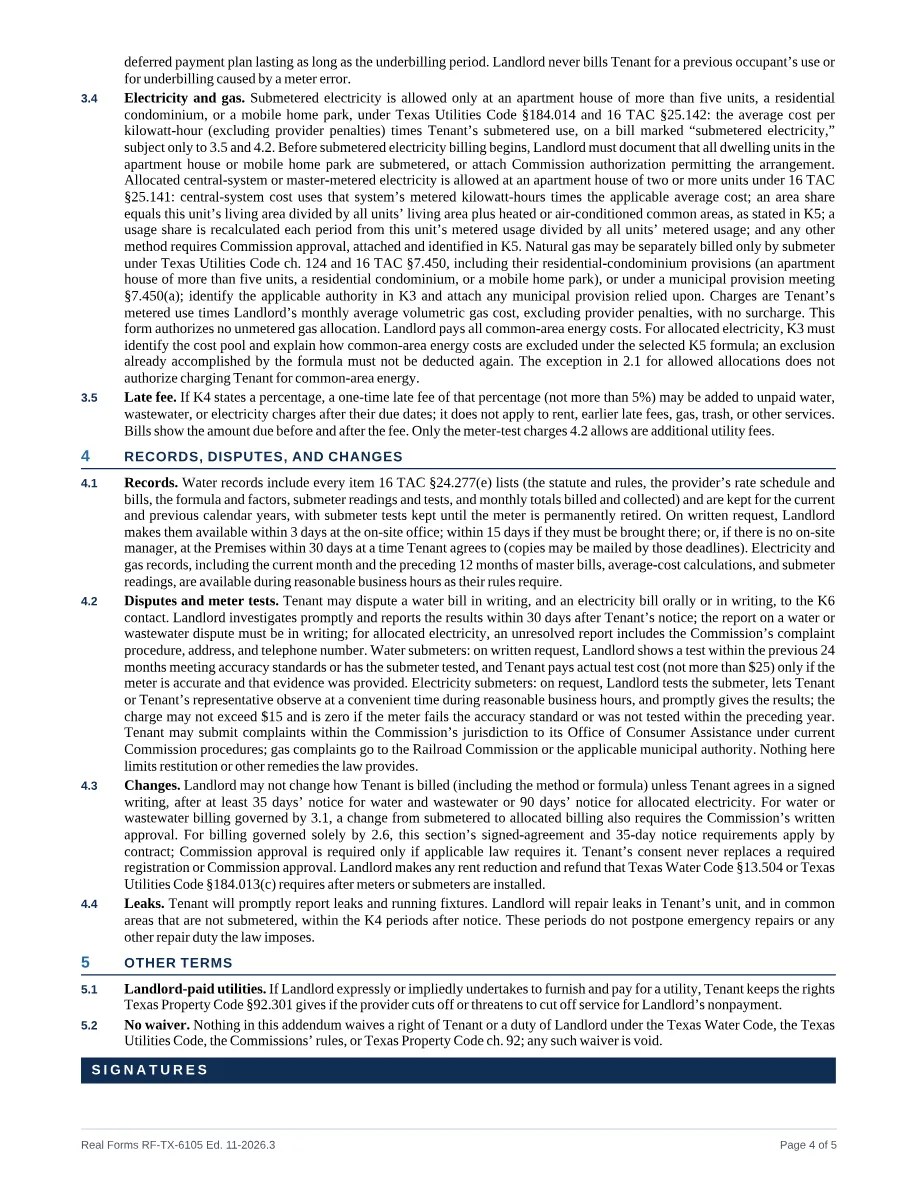
3.4 Electricity and gas. Submetered electricity is allowed only at an apartment house of more than five units, a residential condominium, or a mobile home park, under Texas Utilities Code §184.014 and 16 TAC §25.142: the average cost per kilowatt-hour (excluding provider penalties) times Tenant’s submetered use, on a bill marked “submetered electricity,” subject only to 3.5 and 4.2. Before submetered electricity billing begins, Landlord must document that all dwelling units in the apartment house or mobile home park are submetered, or attach Commission authorization permitting the arrangement. Allocated central-system or master-metered electricity is allowed at an apartment house of two or more units under 16 TAC §25.141: central-system cost uses that system’s metered kilowatt-hours times the applicable average cost; an area share equals this unit’s living area divided by all units’ living area plus heated or air-conditioned common areas, as stated in K5; a usage share is recalculated each period from this unit’s metered usage divided by all units’ metered usage; and any other method requires Commission approval, attached and identified in K5. Natural gas may be separately billed only by submeter under Texas Utilities Code ch. 124 and 16 TAC §7.450, including their residential-condominium provisions (an apartment house of more than five units, a residential condominium, or a mobile home park), or under a municipal provision meeting §7.450(a); identify the applicable authority in K3 and attach any municipal provision relied upon. Charges are Tenant’s metered use times Landlord’s monthly average volumetric gas cost, excluding provider penalties, with no surcharge. This form authorizes no unmetered gas allocation. Landlord pays all common-area energy costs. For allocated electricity, K3 must identify the cost pool and explain how common-area energy costs are excluded under the selected K5 formula; an exclusion already accomplished by the formula must not be deducted again. The exception in 2.1 for allowed allocations does not authorize charging Tenant for common-area energy.
3.5 Late fee. If K4 states a percentage, a one-time late fee of that percentage (not more than 5%) may be added to unpaid water, wastewater, or electricity charges after their due dates; it does not apply to rent, earlier late fees, gas, trash, or other services. Bills show the amount due before and after the fee. Only the meter-test charges 4.2 allows are additional utility fees.
4 Records, Disputes, and Changes
4.1 Records. Water records include every item 16 TAC §24.277(e) lists (the statute and rules, the provider’s rate schedule and bills, the formula and factors, submeter readings and tests, and monthly totals billed and collected) and are kept for the current and previous calendar years, with submeter tests kept until the meter is permanently retired. On written request, Landlord makes them available within 3 days at the on-site office; within 15 days if they must be brought there; or, if there is no on-site manager, at the Premises within 30 days at a time Tenant agrees to (copies may be mailed by those deadlines). Electricity and gas records, including the current month and the preceding 12 months of master bills, average-cost calculations, and submeter readings, are available during reasonable business hours as their rules require.
4.2 Disputes and meter tests. Tenant may dispute a water bill in writing, and an electricity bill orally or in writing, to the K6 contact. Landlord investigates promptly and reports the results within 30 days after Tenant’s notice; the report on a water or wastewater dispute must be in writing; for allocated electricity, an unresolved report includes the Commission’s complaint procedure, address, and telephone number. Water submeters: on written request, Landlord shows a test within the previous 24 months meeting accuracy standards or has the submeter tested, and Tenant pays actual test cost (not more than $25) only if the meter is accurate and that evidence was provided. Electricity submeters: on request, Landlord tests the submeter, lets Tenant or Tenant’s representative observe at a convenient time during reasonable business hours, and promptly gives the results; the charge may not exceed $15 and is zero if the meter fails the accuracy standard or was not tested within the preceding year. Tenant may submit complaints within the Commission’s jurisdiction to its Office of Consumer Assistance under current Commission procedures; gas complaints go to the Railroad Commission or the applicable municipal authority. Nothing here limits restitution or other remedies the law provides.
4.3 Changes. Landlord may not change how Tenant is billed (including the method or formula) unless Tenant agrees in a signed writing, after at least 35 days’ notice for water and wastewater or 90 days’ notice for allocated electricity. For water or wastewater billing governed by 3.1, a change from submetered to allocated billing also requires the Commission’s written approval. For billing governed solely by 2.6, this section’s signed-agreement and 35-day notice requirements apply by contract; Commission approval is required only if applicable law requires it. Tenant’s consent never replaces a required registration or Commission approval. Landlord makes any rent reduction and refund that Texas Water Code §13.504 or Texas Utilities Code §184.013(c) requires after meters or submeters are installed.
4.4 Leaks. Tenant will promptly report leaks and running fixtures. Landlord will repair leaks in Tenant’s unit, and in common areas that are not submetered, within the K4 periods after notice. These periods do not postpone emergency repairs or any other repair duty the law imposes.
5 Other Terms
5.1 Landlord-paid utilities. If Landlord expressly or impliedly undertakes to furnish and pay for a utility, Tenant keeps the rights Texas Property Code §92.301 gives if the provider cuts off or threatens to cut off service for Landlord’s nonpayment.
5.2 No waiver. Nothing in this addendum waives a right of Tenant or a duty of Landlord under the Texas Water Code, the Texas Utilities Code, the Commissions’ rules, or Texas Property Code ch. 92; any such waiver is void.
SIGNATURES
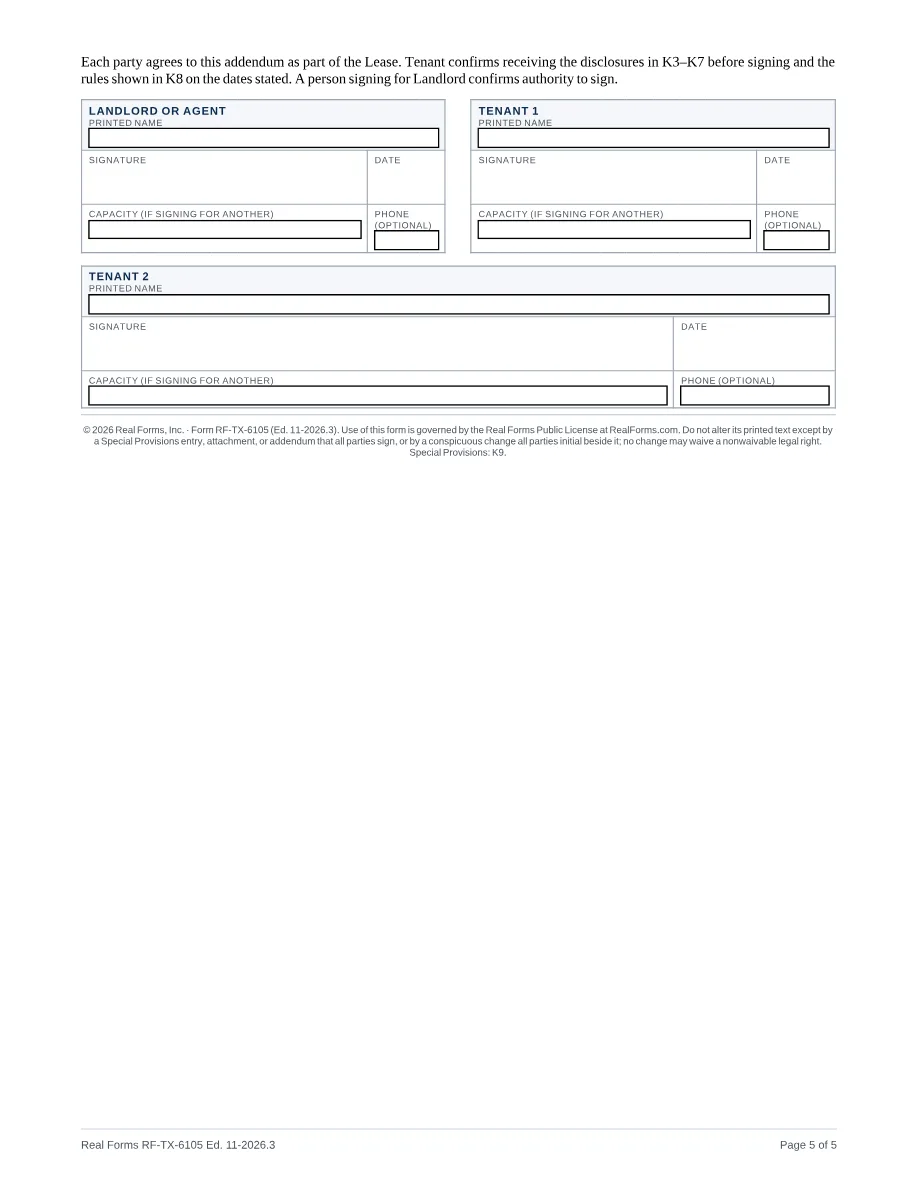
Each party agrees to this addendum as part of the Lease. Tenant confirms receiving the disclosures in K3–K7 before signing and the rules shown in K8 on the dates stated. A person signing for Landlord confirms authority to sign.
Landlord or agent Printed name Signed by (owner, agent, or manager) | Tenant 1 Printed name Tenant 1 — full legal name | |||||||||||||||||||||||||||
Signature | Date | Signature | Date | |||||||||||||||||||||||||
Capacity (if signing for another) Capacity (if signing for another) | Phone (optional) Landlord phone | Capacity (if signing for another) Capacity (if signing for another) | Phone (optional) Phone | |||||||||||||||||||||||||
Tenant 2 Printed name Tenant 2 — full legal name | |||||||||||||
Signature | Date | ||||||||||||
Capacity (if signing for another) Capacity (if signing for another) | Phone (optional) Phone | ||||||||||||
© 2026 Real Forms, Inc. · Form RF-TX-6105 (Ed. 11-2026.3). Use of this form is governed by the Real Forms Public License at RealForms.com. Do not alter its printed text except by a Special Provisions entry, attachment, or addendum that all parties sign, or by a conspicuous change all parties initial beside it; no change may waive a nonwaivable legal right. Special Provisions: K9.
Legal basis
Each row names the law or rule that a part of the form follows. We list these to show how we drafted the form. This is not legal advice.
| Section | What it does | Authority |
|---|---|---|
| K2, 3.1, 3.4 | Separate coverage thresholds for each utility: water at five or more units; electric submetering at more than five; electric allocation at two or more; gas at more than five or a mobile home park | Tex. Water Code §13.501; 16 TAC §§24.275, 25.141, 25.142; Tex. Util. Code §§124.001, 184.011 |
| K4, 3.1 | Prior-year average, highest and lowest bills; allocation formulas and common-area deductions; base and customer charges; a service charge of up to 9%, with exclusions for low income housing tax credit units and Section 8 voucher tenants | 16 TAC §§24.279, 24.281; Tex. Water Code §§13.503, 13.5031 |
| 3.2, 3.3 | Bill contents, 16-day and 7-day due dates, estimates, overbilling and underbilling, and deferred-payment-plan thresholds | 16 TAC §§24.283, 25.141(e), 25.142(d) |
| K5, 3.4 | Electricity allocated by area or usage, with both prior-year averages disclosed; submetering only if all units are submetered | Tex. Util. Code §184.052; 16 TAC §§25.141, 25.142 |
| 3.4, 3.2 | Natural gas billed by submeter only, at cost, with no surcharge; extreme-weather deferral | Tex. Util. Code ch. 124; 16 TAC §§7.450, 7.460 |
| 4.1, 4.2, 4.3 | Access to records, disputes, meter tests ($25 water, $15 electric), changes of billing method, and complaints | 16 TAC §§24.277, 24.287, 25.142(f), 22.242 |
| 2.5, 5.1 | No interruption of a utility and no reconnection fee; tenant rights when the landlord does not pay a utility bill | Tex. Prop. Code §§92.008, 92.301 |
Form history
Each version lists the sentences added or removed since the one before it.
Ed. 11-2026.3
First edition
About this form
The addendum records which utilities and services the landlord bills (water, wastewater, electricity, natural gas, trash and recycling, and others), the billing method for each, and the billing history and allocation details the form calls for. Its terms cover what a bill may include, due dates, corrections, late fees, access to billing records, disputes and meter tests, changes of billing method, and leak repairs. It states that the landlord will not interrupt a utility for nonpayment or charge a reconnection fee. It becomes part of the lease when all parties sign.
Questions about this form
What is this form for?
It is for leasing a property. It has fields for the landlord and the tenant.
Which states is this form for?
It is written for use in Texas.
What information do I need to fill it in?
The form has 69 fields. You need details about the landlord, the tenant and the property. The Preview tab shows the pages.
Has this form been reviewed?
No reviews are listed for this form yet.
Is this an official state form?
No. Real Forms, Inc. created this form. It is available under an open-access license for individuals and a commercial license for use in technology platforms. No state agency issues it.
Which laws and rules apply to this form?
The Legal basis tab lists the laws and rules behind this form, including Tex. Water Code §13.501; 16 TAC §§24.275, 25.141, 25.142; Tex. Util. Code §§124.001, 184.011, 16 TAC §§24.279, 24.281; Tex. Water Code §§13.503, 13.5031 and 16 TAC §§24.283, 25.141(e), 25.142(d).
How do I download it?
Choose Download on this page. You need a free account to download or fill in a form.
Which version is this?
This is version 1, last updated November 14, 2026.